Napoleon vs Snowball: Who's the Real Villain?
In Animal Farm, Napoleon brands Snowball a traitor—but what if we've been deceived? Examining the evidence reveals who the real villain truly is.
Posted by
 Fred
FredRelated reading
Frankenstein: Who's the Monster?
Exploring Mary Shelley's classic novel: Is the real monster Victor Frankenstein or his creation? A deep dive into the themes of responsibility and humanity.
Introduction
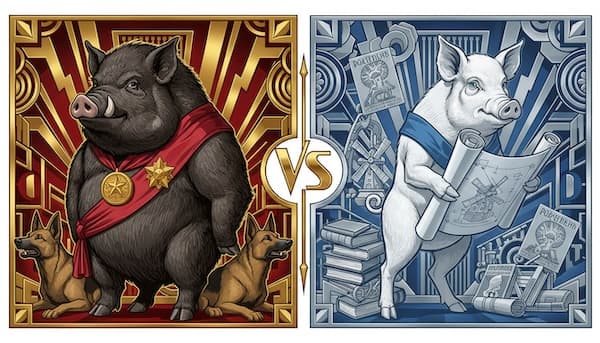
In Animal Farm, Napoleon brands Snowball a traitor—a dangerous enemy sabotaging the farm from the shadows. Every broken windmill, every shortage, every failure is blamed on Snowball's phantom treachery. But what if we've been deceived? History, after all, is written by the victors. Napoleon controls the narrative, but examining the evidence reveals a darker truth: the pig pointing fingers might be the real villain, while his exiled rival was simply inconvenient to his hunger for power. Who do we believe—the propagandist or the banished? The answer exposes tyranny's oldest trick.
Snowball's Vision
Snowball champions the windmill, literacy programs, and committees to improve animal welfare. He studies, debates, and genuinely engages with Animalism's principles. During the Battle of the Cowshed, he fights bravely alongside the animals. His crime? Disagreeing with Napoleon. There's no evidence of actual treachery—only Napoleon's claims after Snowball's violent expulsion. The accusations emerge conveniently when Napoleon needs scapegoats for his failures. Snowball's real threat wasn't sabotage; it was offering an alternative leadership that didn't require fear, violence, or absolute control. His exile removed the only voice capable of challenging Napoleon's corruption.
Napoleon's Calculated Tyranny
Napoleon never argues his positions—he seizes power through his secretly-trained attack dogs, literally using violence to eliminate opposition. He abolishes democratic debate, hoards privileges, trades with humans he once condemned, and constantly revises the Seven Commandments to justify his betrayals. Most damningly, he sends the loyal Boxer to slaughter for profit. Every "Snowball conspiracy" emerges when Napoleon needs to distract from failed policies or tighten his grip. His villainy isn't passionate or reactive—it's methodical, calculating, and sustained. He doesn't corrupt power gradually; he orchestrates tyranny from the beginning.
The Power of the Lie
Napoleon's true genius is making others believe his lies. Squealer rewrites history, and the animals, overworked and barely literate, accept it. Snowball becomes a mythological villain despite his absence—blamed for storms, cow illnesses, even broken eggs. This psychological manipulation is more monstrous than Snowball's alleged crimes could ever be. By controlling the narrative, Napoleon makes the animals doubt their own memories, transforming victims into collaborators. The real villainy isn't what Snowball supposedly did in secret—it's what Napoleon did in plain sight while everyone looked elsewhere. The visible tyrant escapes blame by creating an invisible monster.
Conclusion
Napoleon is Animal Farm's true villain—not despite blaming Snowball, but because of it. Creating phantom enemies is tyranny's signature move, distracting from real oppression with imaginary threats. Snowball's only crime was standing in a dictator's way. Meanwhile, Napoleon orchestrates betrayal, violence, and exploitation while the animals search for external enemies. Orwell's warning echoes beyond the farm: the monster isn't always the one we're told to fear. Sometimes the monster is the one doing the telling, and the greatest evil wears the mask of protector while pointing accusatory fingers elsewhere.
